
Niche-Knack · Android · Linux · Windows · macOS
Every debt you have is a boss fight.
You have been fighting them for years without the satisfaction of watching one go down. Pick a champion, commit a payment, and take the swing yourself — over real double-entry books that would still be correct if the dragon were not there.
Windows, macOS and Linux come straight from this site rather than from a store.
Not out yet. No store listing is open and the checkout is not built, so nothing here can be bought or downloaded today. The terms, when it does ship.
- Every debt is a boss
- A readiness sheet that says “unrated”
- Simple, HUD, Tranquil, and Campaign
- Plain-text books you can take anywhere
- No account or telemetry
The exchange
Somebody has to throw the punch. It should be you.
A payment comes due under its fight, in a box you can change your mind about. Commit it and the dragon draws breath and looses it, and then your champion answers.
Pay what you owed and the dragon takes its shot and misses. Come up short and you feel it — which is the only reason the good months mean anything.
Not this month? Skip it, and watch the other half of the truth: the dragon swings, and nothing answers. The fight remembers — catch up later and the wound closes.
Nothing about that is decoration. It is the payment your books are about to record, played at the speed of a decision instead of a form.
The card turns over
Set the fight up without leaving it.
Tap a fight and the card turns over to what pays it: how much, how often, out of which account. The amount is already filled in, the cadence is already your pay schedule, and whoever paid it last is already suggested — so the ordinary case is one tap and back to the fight.
It will never move a cent by itself. Everything it sets up is a reminder that shows up when it is due and waits for you. An app that quietly paid things would turn the campaign into a spectator sport, and your books into something that happened to you.
The rule the whole thing rests on
You make every move. It only ever reminds you.
Which is also why the fights are worth watching. A bar that moved on its own would be a screensaver.
Home
Three questions, in the order you ask them.
Where things are heading, how ready you are, and what you are fighting. Nothing else — the accounts and the register have pages of their own and are better read there.
The charts are a deck you flick through rather than a wall you scroll past. Land on the flow and it opens out into the whole cash-flow Sankey: every dollar that came in, and where it went. A pane with nothing to say does not show up at all, and a brand-new ledger gets told what to do first instead of three empty boxes.
Financial readiness
A character level that admits what it doesn't know.
Six dimensions, each a question worth asking. Do I keep any of what I earn? How long could I live on what is liquid? How much of it is already promised? Do I own more than I owe? Is my income steady enough to plan against? Do I have a plan, and does it survive contact?
A dimension it cannot answer yet reads unrated — not zero, not "average" — and tells you what it is waiting for. Below three answered there is no overall level at all. Most apps would have shown you a number by now. This one would rather be useful later than confident today.
What it will not do
Guess, round up, or dress a single data point as a verdict.
Every threshold either cites the research it came from or is labelled on screen as a chosen figure.
Pick your class
Four interfaces. Same books underneath.
Simple stays out of the way. HUD is a dark telemetry console. Campaign is a tabletop character sheet with eight hand-drawn champions to choose from, each with a swing of their own — colour their hair and skin and send them in.
Tranquil takes the same fight and reads it as a garden: the bar fills as the debt falls, a plant growing rather than a monster dying. Not a re-skin — the same arithmetic, told the other way round.
Shared with Pocket Nerd, and chosen per device, so the phone can be cozy while the desktop is a cockpit.

Mobile field kit
The phone is real LedgerKeep — not a remote control.
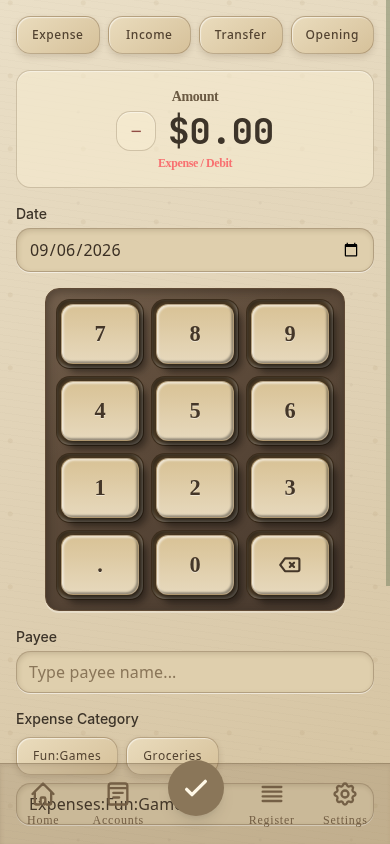
Create books on Android, switch among ledgers, import an existing file or a whole Ledger folder, and record expenses, income, transfers and opening balances on a keypad built for the job.
Pair with the desktop over your own Wi-Fi when you want both. The desktop brings the space; the phone is already in your hand where the money is being spent.
Questions people actually ask
Is the game layer just points and streaks bolted on?
No. There are no points, no streaks, no loot boxes, and nothing rewards you for spending. Every figure the campaign shows is one your books already contain, which you can check by hand. It is the reason Tranquil can read the same fight as a garden growing without anything being rewritten.
What does it cost?
$39 once for this major version. 14-day evaluation, then read-only until you license it. 14-day evaluation with everything on while you decide. Point releases within that major version are included; a future major version would be a separate, discounted purchase. Nothing is on sale yet.
What happens after the evaluation?
Your books remain open, readable, and exportable. Adding and changing entries waits until you license the app. Nothing is deleted.
Will it move money on its own?
Never. Everything it sets up is a reminder: it surfaces when it is due and waits for you to commit it or skip it. Nothing is paid, transferred or filed behind your back, which is the whole reason the campaign is worth playing — you are the one making the moves.
What file format does it use?
Standard plain-text Ledger files. You can open the .ledger files in a text editor or use them with the wider Ledger ecosystem. Your financial history is not trapped in a proprietary database.
Can the phone work without the desktop?
Yes. Android can create and manage real books, record expenses, income, transfers, and opening balances, switch between ledgers, and import existing Ledger files or folders. Desktop adds the roomier command-center experience.
How do devices sync?
Phone and desktop can pair by QR code and exchange books directly over your own Wi-Fi. Changes have local Git history, making the process inspectable and recoverable instead of silently replacing your records.
What is the readiness sheet standing on?
Six dimensions — cash flow, buffer, debt load, solvency, steadiness and plan — each computed from your own transactions. A dimension it cannot compute is shown as unrated, never as zero and never as a plausible guess, and it tells you what it is waiting for. Below three rated dimensions there is no overall level at all, because a confident score built on one number would be worse than no score.
Do I have to be paid on the 1st and the 15th?
No. The budget period follows your actual pay schedule: twice a month, monthly, every two weeks, weekly, annually, or irregular dates you enter yourself. A period runs from one payday up to and including the day before the next.
How does Pocket Nerd fit?
Pocket Nerd is the lightweight run between paydays. LedgerKeep is the permanent campaign history. A completed Pocket Nerd period can arrive in LedgerKeep’s review inbox rather than being entered twice.
Go and kill something.
Windows, macOS and Linux come straight from this site rather than from a store.
Not out yet. No store listing is open and the checkout is not built, so nothing here can be bought or downloaded today. The terms, when it does ship.